
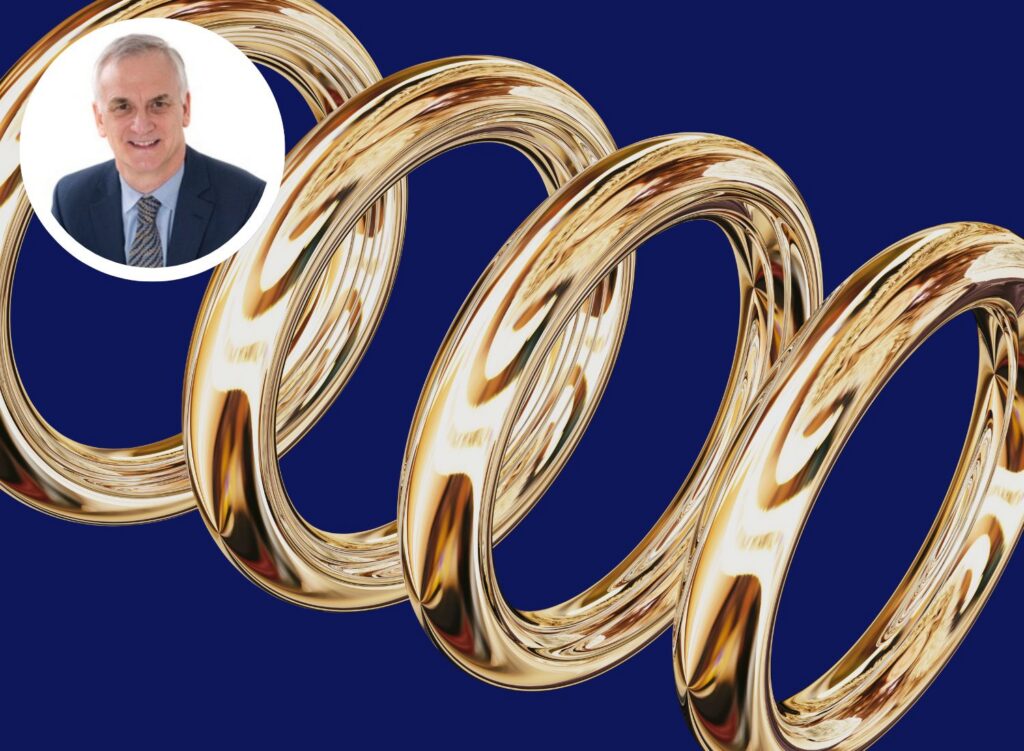
As the first independent Chair of the London Bullion Market Association and following a distinguished 26-year career at the Bank of England, including service on the Monetary Policy Committee, Paul Fisher has been at the forefront of monetary policy, financial markets and bullion market governance. In this conversation, he explores the changing role of gold in the global financial system, the importance of market integrity and responsible sourcing, and the economic and geopolitical forces shaping the decade ahead.
Having served as the first independent Chair of the LBMA for nearly a decade, what do you consider to be the most significant changes you have witnessed across the global bullion market during that period?
There have been several very significant changes.
In no particular order, I would start with the growing importance of responsible sourcing. When I joined the LBMA, we already had Responsible Sourcing Guidance in place, but its origins lay in a response to the US Dodd-Frank legislation of 2010. The focus was primarily on ensuring that material was not sourced from war zones or areas of conflict.
Since then, the guidance has expanded considerably. There is growing pressure from stakeholders and international organisations, such as the OECD, to ensure that gold is sourced both responsibly and sustainably. At the LBMA, we incorporated environmental considerations into that framework. In fact, we began doing so before much of the wider climate-change agenda gathered momentum. The objective was to stay ahead of the curve, rather than simply respond to changing expectations.
A second major development has been the globalisation of the gold market, particularly China’s growing role within it. China is both the world’s largest producer and largest consumer of gold, and Chinese market participants have become increasingly engaged with the LBMA and the Good Delivery List (GDL) system. Although Chinese-produced bullion does not enter international markets, GDL accreditation has become highly valued as a globally recognised benchmark, and the LBMA itself has evolved into an international organisation.
One is seeing a similar trend in the platinum and palladium markets. At present, Chinese institutions are seeking the international recognition that the GDL standards provide, across all precious metals.
Whether or not China delivers to the international market, it could be disruptive for China to adopt differing standards. It is therefore important that we continue to ensure the global market standard remains relevant to China. The LBMA has Chinese firms actively involved, including at Board level, and that international engagement is an important part of the organisation’s continued development.
The third major change has, of course, been the rise in the gold price. It is remarkable how much more attention gold attracts when prices increase! When I became Chair, gold was trading at around US$1,300 per ounce. Today it is over three times higher, and that has fundamentally changed the level of interest from investors, policymakers and the wider market alike.
The LBMA recently held its Responsible Sourcing and Sustainability Summit in London. What were the main themes from the event, and what stood out to you most?
The central theme of this year’s Summit was artisanal and small-scale mining (ASM).
LBMA recognises that around 20 percent of global gold production comes from artisanal and small-scale mines, yet very little of that material enters the legitimate market through Good Delivery refiners. Instead, much of it flows – unrecorded – to elsewhere, and we have to assume that a significant proportion ends up in illicit supply chains, potentially funding organised crime and possibly even terrorist activity.
This is a challenge the entire industry must address collectively. And even then the industry cannot solve it on its own. Ultimately, enforcement rests with the authorities in the countries where the artisanal gold is produced, but the rest of the industry has an important role to play in supporting practical solutions.
One example is the LBMA’s Artisanal Mining Toolkit, which provides a framework for national authorities and market participants to help bring responsibly mined ASM into the legitimate supply chain. Large-scale mining companies can also contribute through technical assistance and by sharing expertise.
Some may view ASM as a competitive issue, but I think that is the wrong perspective. Gold that remains outside the GDL market damages the reputation of the industry as a whole, and that benefits nobody. By contrast, responsibly sourced ASM represents an additional source of supply for refiners, and there is a genuine opportunity to create a solution that works for everyone.
There are already encouraging examples of progress. As an example at the Summit, Rand Refinery shared the work it is doing in Ghana and elsewhere in Africa to support responsible ASM sourcing. Some of the risks can be mitigated, although part of the challenge has been that, as responsible sourcing standards rightly became more stringent, many refiners concluded that ASM was simply too risky to engage with.
Part of the solution going forward must be to distinguish responsibly mined ASM from illegally mined material. It is that responsibly produced gold that needs help to be integrated into the formal market.
For that to happen, the incentives need to work for everyone. Artisanal miners need a clear commercial incentive to sell into legitimate supply chains. Producing countries need effective frameworks to manage the sector and tackle illegal mining. Refiners need a commercially viable route to processing the material responsibly.
If we can achieve that, the potential benefits are considerable. Countries such as Ghana, for example, could see more of that gold entering formal channels and potentially becoming part of their foreign exchange reserves. It is, in many respects, a win-win.
This is certainly not an easy challenge, otherwise it would have been solved long ago. Nevertheless, we have to continue working to help reduce the flow of gold into illicit markets. If we fail to do so, others will ultimately impose solutions on the industry, and those are unlikely to be as practical or as effective as the ones it can develop itself.
Your career has been defined by service at the highest levels of public policy and financial decision-making. Looking back, what experiences have most shaped your understanding of leadership, responsibility and stewardship?
There are several principles that have shaped my thinking over the years.
The first is integrity. Whether you are in public service or the private sector, you should never do something that you will be ashamed of later. Another way of putting it is simply to ‘always act with integrity’. If you do that consistently, you are unlikely to encounter serious problems. If you knowingly act without integrity, however, sooner or later you will be found out.
Equally important is ensuring that your decisions are capable of withstanding scrutiny. When I was at the Bank of England, I would often ask myself a simple question: if I had to defend this decision in front of the Treasury Select Committee, how would it sound? If a course of action could not be publicly justified, you simply should not pursue it. Your decisions should be able to stand up in the court of public opinion.
The second lesson is that leadership is truly defined during periods of crisis. What matters is not how things operate when everything is running smoothly, but how decisions are made and leadership is demonstrated when circumstances become difficult. I learned that lesson quite early in my career.
The ‘design-for-crisis’ principle applies whether designing institutions, markets or regulations. Whether at the Bank of England or organisations such as the LBMA and LPPM, one has to prioritise what happens when things go wrong. Rules matter most when markets are under stress, not when everything is functioning normally.
Many people are reluctant to contemplate crises, but crises occur far more often than most imagine. One of the lectures I have given regularly focuses on crisis management, because over the course of a 20-year career one is likely to experience many significant crises – almost every year in my case! Ultimately, your career can often be defined by the decisions you make when the pressure is greatest.
That is why anticipating risk is so important. You need to think carefully about where things might go wrong and put appropriate mitigants in place. In financial markets, we call that risk management, but it should be driven by a genuine desire to mitigate and manage risk, not simply to satisfy a regulatory requirement or tick a compliance box.
Another lesson I have learned is that, as a leader, you should not try to do everything yourself. If you recruit talented people, you have to allow that talent to flourish. There will occasionally be moments when your experience makes you want to intervene or redirect the team. But those moments should be relatively rare. Most of the time, your role is to create the conditions in which capable people can succeed.
And if something goes wrong, you need to be available to support and reinforce your team. Generally speaking, you should employ capable people, allow them to do their jobs, and stand ready to step in when they need your help.
Leadership itself is difficult to teach. Most of us learn it by observing others, and often we learn more from other people’s mistakes than from their successes. I have worked alongside excellent leaders, seen otherwise excellent leaders make mistakes, and also witnessed examples of very poor leadership. One absorbs those experiences and gradually develops one’s own approach.
The important thing is to think consciously about leadership. If you never stop to consider what good leadership looks like, the chances of getting it right by accident are relatively small. There are different leadership styles for different situations. Sometimes you stand back and allow others to lead. Sometimes you have to take charge. Sometimes things have to happen simultaneously, while at other times they must happen in sequence. The more experience you gain, the more instinctive those judgements become.
Ultimately, I believe the true measure of leadership comes when things go wrong. That is the moment to take responsibility rather than look for someone else to blame. A leader accepts responsibility, supports the team, and focuses on putting things right. To me, that is one of the clearest markers of genuine leadership.
Trust has always been central to both financial markets and precious metals markets. In your view, what are the key governance, transparency and responsible sourcing challenges that the bullion industry must continue to address in the years ahead?
Trust, on its own, can easily be abused. That is why trust and verification have to go hand in hand.
Markets need rules. Most participants will seek to follow them. Some will fail to do so inadvertently and need guidance, while others will deliberately ignore them. That is why trust alone is not enough. It must be supported by rules that are both credible and enforceable.
One of my favourite observations is that every successful market, for thousands of years, has been built on those twin foundations of trust and enforceable rules.
Ultimately, every transaction depends on confidence. The seller has to be confident that the buyer will pay as agreed, and the buyer has to be confident that the seller is delivering exactly what has been promised. It does not matter whether you are trading a financial instrument or a cart of apples. You have to trust that the product is what it claims to be, and that is precisely where governance and market standards become so important.
The objective, however, is not to regulate for the sake of regulation. Rules should support markets and encourage confidence, not inhibit innovation or restrict legitimate trading. They should create the conditions that allow markets to function efficiently.
Gold is no different. While you may not face the same counterparty credit risks that are associated with many other financial assets, you do have to trust that the gold exists, that it is securely stored and that it is being safeguarded responsibly. That is why institutions such as the Bank of England and the Federal Reserve Bank of New York continue to play such an important role as vaults. Their secure infrastructure provides confidence that the underlying asset is exactly where it is supposed to be.
Beyond that, trust in the gold market ultimately comes down to two issues: the purity of the metal and its provenance. Purity is something the industry monitors continuously, using well-established techniques and standards. Provenance, however, raises more complex questions.
Historically a significant amount of gold would have been produced in conditions that would be regarded as nothing short of abhorrent today. The legal and ethical standards existing at that time were a lot lower. Nevertheless, a bar of gold bullion that has been in the vaults for a hundred years is just a bar of metal which remains fungible in the market with a bar produced subject to modern standards. Re-casting an old bar would not change history. But we can change the present and the future: We must continually look to keep raising the standards bar.
Ultimately, you cannot blame the gold itself. You can blame the people. Otherwise, it is rather like blaming a car for an accident. The vast majority of car accidents happen because of actions by the drivers, not their cars. And even if there is a fault with the car then the root cause will be in what a mechanic/ manufacturer/ designer has done.
The same principle applies in financial markets. People make mistakes, not markets.
Looking ahead, what developments, whether economic, geopolitical, technological or regulatory, do you believe are most likely to shape the future of the gold market over the next decade?
There are two developments that stand out.
The first is what I see as the early signs of a gradual erosion of confidence in the U.S. dollar as the world’s reserve currency. We have already seen evidence of that. Recently, the ECB reported that gold had displaced U.S. Treasuries as the world’s most commonly held reserve asset by value. That is a reflection of the higher gold price of course, but it also reflects sustained buying by central banks.
The country that issues the world’s reserve currency enjoys an extraordinary privilege. It can finance its debt more easily, sustain current account deficits and support higher levels of domestic consumption. At the same time reserve currency status brings considerable geopolitical influence, including the ability to impose financial sanctions not just for criminal activity but also to exert pressure for political reasons.
If that influence is perceived as being used too extensively, countries inevitably begin to question whether they should remain so heavily dependent on a single reserve currency. We have seen and heard increasing evidence of that question being asked in recent years. Many countries, including those that consider themselves neutral rather than politically or militarily opposed to the United States, are asking how they can diversify their reserves away from the dollar and thus reduce their exposure to geopolitical risks.
Gold is one of the few obvious alternatives to the dollar. At present, there is simply no other fiat currency with financial markets as deep and liquid. The euro is a major reserve currency, but its sovereign debt market is fragmented across issuers with different credit profiles. The Chinese renminbi is not yet fully convertible. Gold however, is a growing market, and recent research shows that it has liquidity properties which are superior to most financial assets, including those considered to be High Quality Liquid Assets (HQLA) for regulatory purposes. Given that there is no true currency alternative, one should not be surprised that gold has become increasingly important within official reserves. I believe that trend is likely to remain one of the defining drivers of the market over the coming years.
The second major development is technology.
We are seeing advances across artificial intelligence, distributed ledger technology and, potentially, central bank digital currencies. While central bank digital currencies have not yet gained significant traction, particularly among the major reserve currencies, I believe they will eventually become part of the financial landscape.
The same is true of the way investors access gold. Today we already have highly developed derivatives markets and exchange-traded funds, but over time we are also likely to see further growth in tokenised gold and other digital forms of ownership. A number of tokenisation projects already exist, although none has yet emerged as the dominant model.
That said, I do not believe physical gold will lose its importance. In many parts of the world, people value gold precisely because it is tangible and independent of domestic currencies or financial institutions, particularly where confidence in those currencies and institutions is limited. Physical ownership will therefore remain an important part of the market.
At the same time, there is also a large group of investors who have little or no exposure to gold, not because they question its value, but because they have no desire to hold and store physical bullion themselves or even in a vault. For them, digital access through well-regulated financial products could make gold a much more practical element of portfolio allocation. I would never advocate concentrating an entire portfolio in any single asset, whether that is gold, U.S. Treasuries or anything else. But for investors seeking a modest allocation, perhaps five or ten percent, more legitimate avenues for gaining exposure to gold are likely to broaden market participation.
From a market standards perspective, however, one principle should remain unchanged. Derivatives, tokens and similar products should ultimately be backed by good quality physical gold. That underlying metal should meet GDL standards, be securely vaulted and be responsibly sourced. As long as those foundations remain in place, I see no reason why the market should not continue to evolve and offer investors an increasingly diverse range of ways to access gold.
