
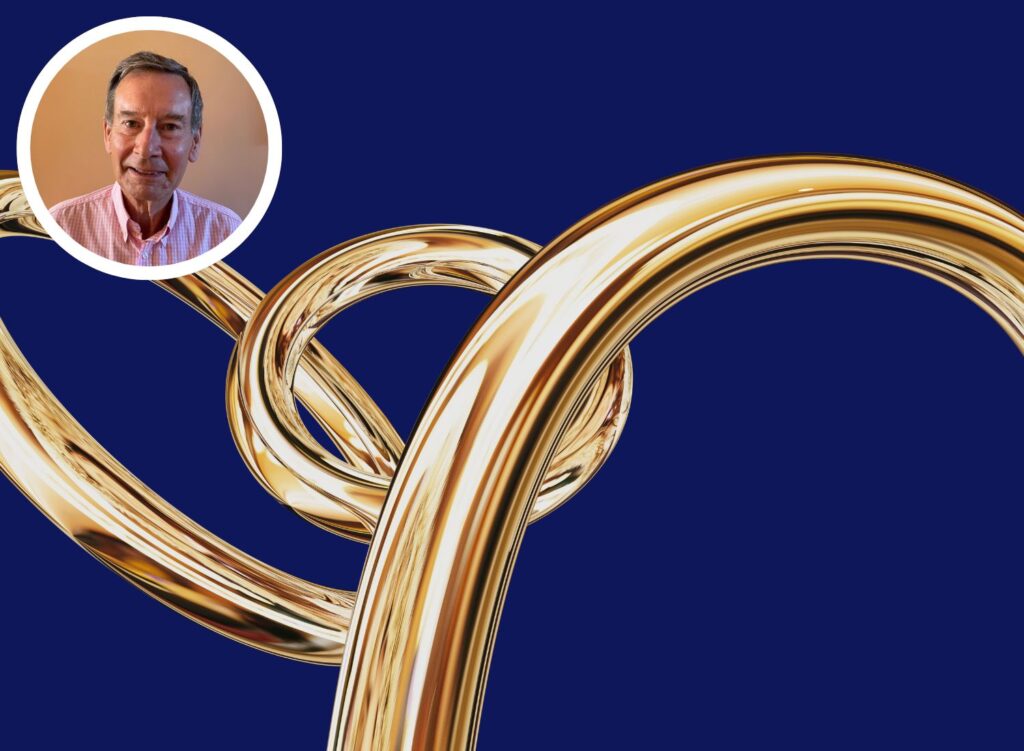
With leadership roles at De Beers, Platinum Guild International and the Responsible Jewellery Council, James Courage has helped shape markets, build industry support and investment in industry standards, and strengthen consumer confidence across the global jewellery and precious metals sector. In this exclusive interview, he reflects on four decades in the industry – from developing platinum jewellery markets in China and India to advancing responsible practices and fostering collaboration across the supply chain.
Mr. Courage, you’ve spent decades shaping consumer markets across the jewellery sector – from De Beers to the Platinum Guild. What originally drew you to this industry, and what’s kept you engaged over the years?
After a short career in banking, serendipity took me to De Beers, where I joined the financial PR team. We worked mainly with the media and the mining and financial community on the trade side, and I also collaborated with the European Diamond Council, an initiative of De Beers that brought together leaders of Europe’s leading jewellery trade associations to share research and develop retail educational programmes. At the time, in the 1970s, De Beers was the leading producer of rough diamonds, a key influencer through its control of rough diamond sales and the principal investor in large-scale consumer marketing programmes.
In the early 1980s, I spent two years in the South African PR office of Anglo American and De Beers. One role involved hosting visits by foreign journalists, financial analysts, and members of the international diamond jewellery industry, who had been invited to visit the companies’ diamond, gold, and platinum operations in South Africa. This provided first-hand experience of mining and recovery processes and the opportunity to meet top management and government representatives.
Upon returning to the UK, I joined the De Beers marketing department, responsible for jewellery market development in Spain, followed by Germany, the UK, and South Africa. I later became involved with the markets in Canada and the United States. I then moved to Hong Kong to set up a De Beers marketing office covering much of Asia. After two years, I returned to London to head up Platinum Guild International (PGI) in 1996. Drawing on my experience in Asia, I set out to establish a platinum jewellery consumer marketing programme, initially in China and later in India. This gave me significant insight into two major consumer markets, both of which are also key jewellery manufacturing centres for domestic and export markets. India is also the primary cutting centre for rough diamonds.
These experiences complemented my earlier knowledge of mining, jewellery manufacturing, and retailing. I was able to bring them to my roles as Chairman of the Responsible Jewellery Council and as a judge for five years at the JNA Hong Kong Jewellery Awards, held every September at the Hong Kong trade fair. The latter focused on innovation, sustainability, good practices, and promoting young entrepreneurs within the jewellery industry, and both roles kept me closely connected to developments across the precious metals and stones sectors.
As Chairman of the Responsible Jewellery Council, you had a unique vantage point on how membership organisations serve the industry. In your view, what do companies today truly need from a network or council – and how can such platforms stay relevant and valuable in a fast-evolving jewellery and precious metals landscape?
Membership organisations are key to building and maintaining trust, establishing standards, and growing representation across industries and markets. These efforts help set best practices for the benefit of both consumers and participants in the jewellery pipeline. Such organisations often work with constrained budgets, small teams, and challenging mandates to create awareness and support.
The formation of the Responsible Jewellery Council in 2005 brought together 14 leading organisations – including De Beers, Tiffany, and Cartier – to promote responsible practices and ethical standards. Today, as the RJC celebrates its 20th anniversary, it works with over 2,000 companies spanning the entire supply chain for both jewellery and watches. Yet funding remains an ongoing challenge for work that is essential to the industry’s long-term health and consumer confidence.
Platforms can only succeed if leading members of the trade engage, cooperate, and require standards of their suppliers, help smaller organisations participate, and implement processes such as chain of custody, adherence to established ethical standards, and transparency.
In your view, how has the concept of “responsible jewellery” evolved – and where does the gold sector still have work to do?
There will always be challenges, as opportunities to “short-circuit” are hard to eliminate. Much good work has been done within the industry, often without sufficient credit or recognition. Vigilance and engagement remain essential – at the governmental level, as demonstrated by the implementation of the Kimberley Process, and within the industry, as seen in the development and adoption of the CMSI mining and ICMM mining principles.
The gold industry is particularly vulnerable when prices are high. There is ongoing concern about illegal mining operations and the unrecorded movement of gold. Organisations such as the World Gold Council and the LBMA have mandated standards for their members and actively encourage wider industry participation.
What role do industry associations and councils play in driving meaningful, long-term change?
As I’ve mentioned, they are a significant force for change and improvement – both in domestic markets and internationally – by establishing better business practices. Organisations such as the RJC and CIBJO, which themselves have trade association members and supporters including major trade fairs and laboratories, work closely with standards bodies.
There is active dialogue and engagement with NGOs, UN organisations, and other external groups to address shared issues. Collectively, they have developed standards and practices that are now widely supported by the broader industry.
What continues to excite you most about the future of the precious metals and jewellery world – and what advice would you offer to the next generation of leaders?
Jewellery, once the preserve of royalty and the wealthy, is now cherished by a growing population of young consumers, particularly in Asian markets. Whether acquired through tradition, as a symbol of love or success, as a store of value, or as an inherited heirloom, each piece carries personal meaning.
Over more than 40 years, I have seen how jewellery finds new consumers, such as platinum jewellery in China and India. Many in the industry are consciously working to make their businesses more sustainable, transparent, and ethical – but there will always be improvements to make, and much remains to be done. Associations and industry leaders, while making a difference, still need sustained support to meet evolving consumer expectations and the demands of responsible business practices.
When I see my granddaughters’ excitement as they explore their grandmother’s jewellery box, and so many young people wearing both fashion and precious jewellery, it reinforces that the relationship with jewellery remains strong after thousands of years. But it must be nurtured, and trust must be sustained. Today’s and tomorrow’s consumers are far more aware of environmental responsibility and the need for transparency in provenance, process, and business practices.
My experiences across cultures, working with precious metals and stones, and collaborating with talented, creative, and dedicated people have made my engagement with this industry both challenging and extraordinarily rewarding.
